CATEGORY: Conditioners
One of the most common questions in modern hair care is whether a conditioner and a hair mask serve the same purpose. Because both products promise softer, smoother, and healthier-looking hair, many people assume they are interchangeable. Others believe that using one eliminates the need for the other.
In reality, conditioners and hair masks are designed for different roles within a complete hair care routine. While they share certain ingredients and objectives, they differ in concentration, texture, application, and the intensity of care they provide. Understanding these differences helps build a routine that supports the changing needs of the hair throughout the year rather than relying on a single product to perform every task.
Healthy hair rarely depends on one miracle treatment. Instead, it benefits from a balanced routine in which each product performs a specific function. Daily conditioners maintain the hair after every wash, while hair masks provide occasional intensive care when the hair requires additional support.
Why Hair Needs Different Levels of Care
Hair is constantly changing.
Every wash, every brush stroke, every styling session, and every hour spent outdoors gradually affects the condition of the hair fibre. Seasonal weather, humidity, pollution, ultraviolet radiation, swimming pools, colouring, bleaching, and heat styling all influence how much moisture the hair retains and how smooth the protective cuticle remains.
Some days the hair requires only routine conditioning. At other times, especially after prolonged exposure to stress, it may benefit from a richer treatment capable of restoring softness and improving manageability.
Recognising these changing needs is the first step toward building an effective hair care routine.
What Is a Hair Conditioner?
A traditional conditioner is formulated for frequent use after shampooing.
Its primary role is to restore softness after cleansing by smoothing the outer cuticle of the hair. This reduces friction between strands, making brushing easier while improving shine and helping minimise breakage caused by everyday handling.
Most conditioners are designed to remain on the hair for only a few minutes before being rinsed away. Despite this relatively short contact time, they provide an essential level of daily maintenance that supports healthier-looking hair over the long term.
For many people, conditioner becomes the foundation of every washing routine.
What Is a Hair Mask?
A hair mask is a more intensive conditioning treatment.
Although similar in appearance to a rich conditioner, a hair mask generally contains higher concentrations of conditioning agents, moisturising ingredients, emollients, and other supportive components intended to remain on the hair for a longer period.
Rather than being used after every shampoo, hair masks are usually incorporated into the routine periodically, depending on the condition of the hair.
Their objective is not to replace daily conditioning but to provide additional support whenever the hair begins showing signs of dryness, roughness, reduced elasticity, or increased difficulty during styling.
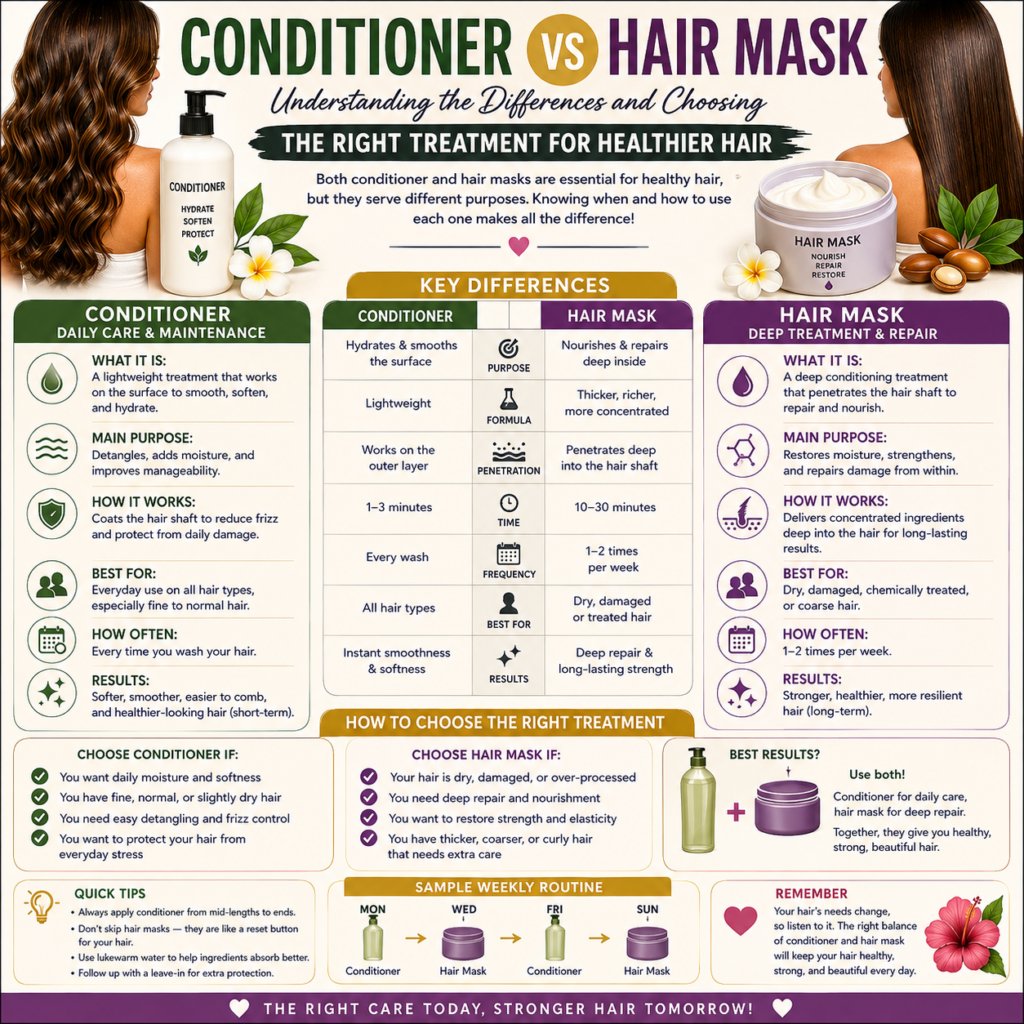
The Main Differences Between Conditioners and Hair Masks
Although they belong to the same family of hair care products, several important differences distinguish them.
Frequency of Use
Conditioners are generally suitable after every shampoo.
Hair masks are typically used less frequently, allowing them to complement rather than replace routine conditioning.
The appropriate frequency depends on individual hair needs, chemical history, and environmental exposure.
Texture
Conditioners are usually lighter in consistency, allowing them to spread easily through the hair and rinse away without leaving excessive residue.
Hair masks are noticeably richer and creamier because they are intended to provide more intensive conditioning during longer application times.
Purpose
Daily conditioners focus primarily on maintaining softness, reducing tangles, and supporting everyday manageability.
Hair masks provide additional nourishment during periods when ordinary conditioning may no longer feel sufficient.
Rather than competing with one another, these products perform complementary roles.
When Is Conditioner Enough?
Many people achieve excellent results using only a high-quality conditioner.
Hair that is naturally healthy, untreated, and not exposed to excessive heat styling may require little more than consistent daily conditioning combined with gentle handling.
Individuals with short hair, minimal chemical processing, and relatively low environmental exposure often find that routine conditioning provides all the moisture their hair requires.
Consistency frequently proves more valuable than using increasingly intensive products unnecessarily.
When a Hair Mask Becomes Beneficial
There are situations where deeper conditioning provides noticeable improvements.
After Colouring
Hair colouring temporarily affects the protective cuticle.
A conditioning mask may help restore softness while improving manageability during the days following treatment.
Following Bleaching
Bleached hair often requires additional care because lightening procedures place considerable stress on the hair fibre.
Richer treatments help improve flexibility and reduce the rough texture commonly associated with repeated bleaching.
Seasonal Dryness
Winter heating systems, cold outdoor temperatures, and reduced humidity frequently leave hair feeling noticeably drier than usual.
Many people naturally increase their use of conditioning masks during colder months before returning to lighter routines during warmer seasons.
Long Hair
The ends of long hair may be several years old.
Because these older sections have experienced prolonged exposure to sunlight, brushing, washing, and styling, they often benefit from occasional intensive conditioning beyond daily maintenance.
Can You Use Both Together?
Absolutely.
A balanced routine often includes both products because they perform different functions.
Regular conditioner maintains the hair after each wash, while periodic masks provide additional care whenever the hair requires deeper hydration or improved softness.
Some individuals alternate between the two depending on the condition of their hair, while others schedule weekly or bi-weekly treatments alongside their normal conditioning routine.
There is no universal schedule suitable for everyone.
Observation remains the most reliable guide.
Choosing the Right Product for Your Hair Type
Different hair types respond differently to conditioning products.
Fine hair generally benefits from lightweight conditioners and lighter masks that avoid reducing natural volume.
Curly and coily hair frequently appreciates richer formulations capable of maintaining moisture over longer periods.
Colour-treated hair often benefits from products specifically developed to support chemically processed hair without creating unnecessary heaviness.
The goal is always balance rather than excess.
Common Misunderstandings
One common misconception is that hair masks permanently repair damaged hair.
In reality, neither conditioners nor masks can permanently restore damaged hair fibres because hair is biologically inactive once it grows beyond the scalp.
Instead, these products improve the condition of the existing hair by smoothing the cuticle, reducing friction, increasing softness, and enhancing overall manageability.
Another misunderstanding is that using hair masks more frequently automatically produces healthier hair.
Excessive product use may simply weigh down certain hair types without providing additional benefits.
Selecting products thoughtfully and using them appropriately generally produces the most satisfying results.
Building a Complete Conditioning Routine
An effective routine does not rely on one product alone.
Gentle shampooing, regular conditioning, occasional intensive treatments, careful brushing, sensible heat styling, routine trimming, and healthy lifestyle habits all contribute to maintaining attractive, comfortable hair.
Each product performs a specific role within this larger system.
Rather than searching endlessly for a miracle formula, developing consistent habits often delivers more reliable long-term improvements.
Final Thoughts
Conditioners and hair masks should never be viewed as competitors. Instead, they are complementary treatments that support the hair in different ways. Daily conditioners maintain softness, reduce friction, and improve manageability after every wash, while hair masks provide occasional intensive care when the hair requires additional moisture and nourishment.
Understanding when each product is most appropriate allows you to respond to your hair’s changing needs rather than following rigid routines or marketing trends. By combining consistent daily conditioning with periodic deep treatments when necessary, you create a balanced approach that helps preserve healthier-looking, softer, shinier, and more manageable hair throughout every season of the year.
The End
AMBERSEABEAUTY.COM
 Discover More From Our Family of Websites
 ZodiacBearing (Astrology, Tarot, Numerology, Angel Numbers & Spiritual Guidance)
 Velourana (Beauty, Makeup, Hair Care, Skincare & Beauty Tips)
 HavenBearing (Home, Living, Organization, Décor & Everyday Inspiration)
 PawBearing (Pet Care, Dog Breeds, Animal Health, Training & Pet Products)
 PsyCatherine (Notes From the Journal of a Psychologist on Real Life)