CATEGORY: Conditioners
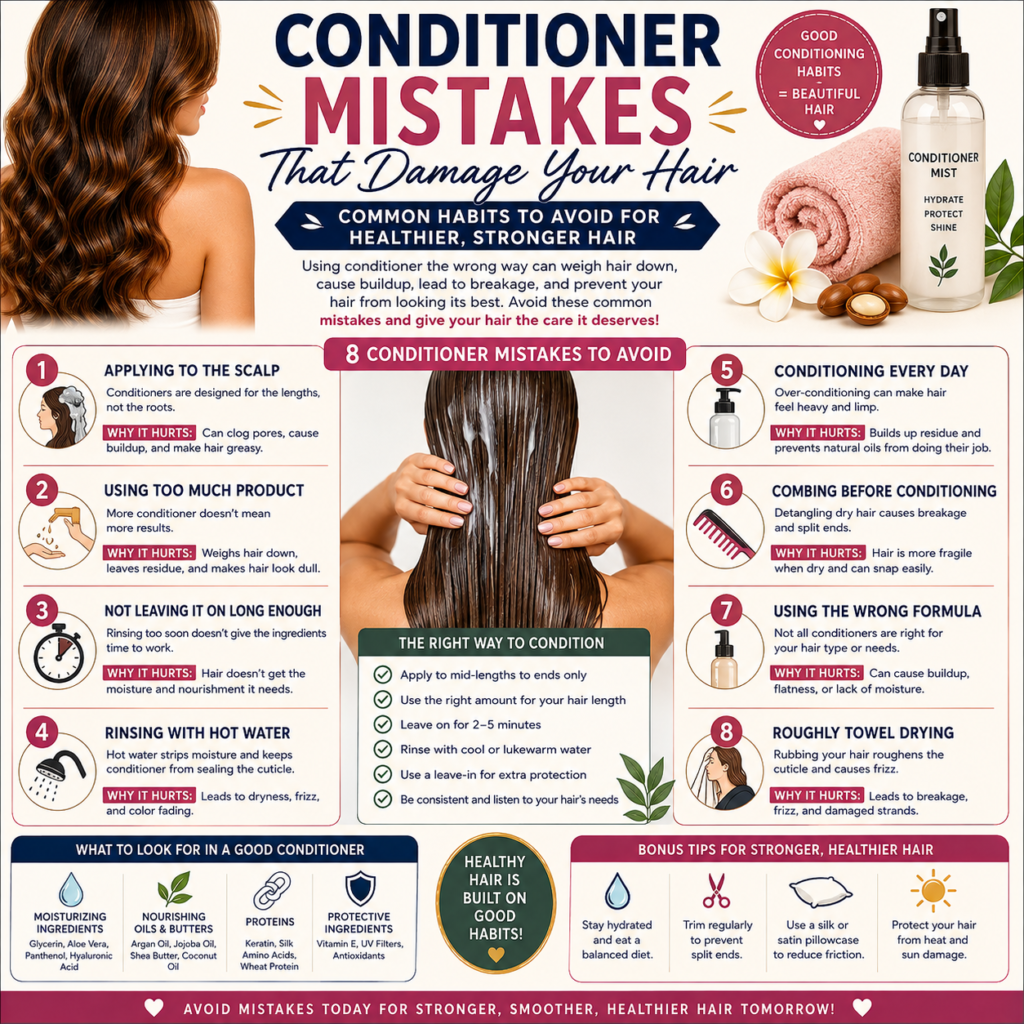
Hair conditioner is one of the simplest products in a hair care routine, yet it is also one of the most frequently misused. Many people assume that once they have applied conditioner after shampooing, they are automatically giving their hair the care it needs. In reality, the way a conditioner is selected, applied, and incorporated into a routine has a significant influence on the final results.
A high-quality conditioner cannot perform at its full potential if it is used incorrectly. Likewise, expensive products often receive unfair criticism simply because they are being applied in ways that prevent them from working effectively. Small habits repeated over weeks, months, and years can gradually affect the appearance, softness, and manageability of the hair without the user even realizing why.
Understanding these common mistakes helps build healthier routines while allowing conditioners to perform as they were intended.
Why Small Habits Matter
Hair does not usually become damaged overnight.
Instead, most changes occur gradually through thousands of everyday actions. Washing too aggressively, brushing wet hair roughly, applying products incorrectly, or exposing the hair to excessive heat all create cumulative stress.
Because conditioner is designed to reduce friction and improve manageability, using it correctly becomes one of the easiest ways to protect hair from unnecessary wear.
The goal is not perfection but consistency. Small improvements in technique often produce noticeable long-term benefits.
Mistake One: Choosing the Wrong Conditioner
One of the most common mistakes occurs before the bottle is even opened.
Many consumers purchase conditioners based on advertising, fragrance, or recommendations from friends without considering whether the formula actually matches their own hair.
Hair differs enormously from one person to another. Fine hair, thick hair, curly hair, chemically treated hair, mature hair, and naturally oily hair all have different conditioning requirements.
Using a rich conditioner designed for coarse curls may leave fine hair heavy and flat. Conversely, a lightweight conditioner intended for oily hair may provide insufficient moisture for dry or damaged strands.
The best conditioner is always the one that suits your own hair rather than the one currently receiving the most attention.
Mistake Two: Applying Conditioner to Very Wet Hair
Many people apply conditioner immediately after turning off the shower without removing excess water.
When hair is dripping wet, much of the conditioner becomes diluted before it has an opportunity to coat the hair evenly.
Instead, gently squeezing excess water from the hair before applying conditioner allows the product to remain more concentrated, improving its ability to spread uniformly across each strand.
This simple adjustment often makes even familiar conditioners perform noticeably better.
Mistake Three: Using Too Much Product
It is easy to assume that if a small amount of conditioner is beneficial, using twice as much must produce even better results.
Hair care rarely works this way.
Excess conditioner can leave residue on the hair, making it appear heavy, limp, or greasy while offering little additional conditioning benefit.
Most modern conditioners are formulated to perform effectively in moderate quantities.
Using only the amount appropriate for your hair length and thickness generally produces cleaner, lighter, and more natural-looking results.
Mistake Four: Applying Conditioner Everywhere
Conditioner is often applied from the roots to the ends without considering where the hair actually requires moisture.
For most people, the scalp produces natural oils that already help condition the roots.
The oldest and driest sections of the hair are usually the mid-lengths and ends.
Concentrating conditioner where moisture is genuinely needed helps maintain softness without unnecessarily weighing down the hair near the scalp.
There are specialised scalp-conditioning products available, but traditional conditioners are generally intended for the hair lengths rather than the scalp itself.
Mistake Five: Rinsing Too Quickly
Conditioners require time to interact with the hair.
Applying the product and immediately rinsing it away reduces the opportunity for conditioning ingredients to coat the hair fibre effectively.
Even allowing the conditioner to remain on the hair for only a few additional minutes can improve softness, detangling, and manageability.
Many people achieve better results simply by washing the rest of their body before rinsing their conditioner.
Mistake Six: Skipping Conditioner Entirely
Some individuals avoid conditioner because they believe it causes oily hair or reduces volume.
While incorrect product selection may occasionally create these concerns, eliminating conditioner altogether often leaves the hair rougher, more tangled, and increasingly difficult to manage.
Conditioning helps reduce friction between strands, allowing brushes and combs to move through the hair with less resistance.
Without this protective layer, mechanical damage during brushing may gradually increase.
Mistake Seven: Expecting Immediate Transformation
Hair care advertising sometimes creates unrealistic expectations.
Healthy-looking hair develops through consistent routines rather than dramatic overnight changes.
Conditioners improve the appearance and feel of the hair immediately, but their greatest benefits become more noticeable when used regularly over weeks and months.
Patience is often one of the most valuable ingredients in any successful hair care routine.
Mistake Eight: Ignoring Seasonal Changes
Hair does not have identical needs throughout the year.
Cold winter air, indoor heating, strong summer sunlight, swimming pools, sea water, and humidity all influence moisture balance.
Continuing to use exactly the same conditioning routine regardless of changing environmental conditions may not always provide optimal results.
Many people benefit from richer conditioning during colder months and lighter formulations during warmer seasons.
Observing how the hair responds to changing conditions allows routines to evolve naturally throughout the year.
Mistake Nine: Neglecting Deep Conditioning
Regular conditioners perform an important role after each wash, but they are not always sufficient for hair experiencing additional stress.
Colour-treated, bleached, curly, or heat-styled hair often benefits from periodic deep conditioning treatments that provide more intensive hydration and softness.
Skipping these treatments does not immediately damage the hair, but incorporating them into an overall routine often improves long-term manageability and comfort.
Mistake Ten: Using Excessive Heat Immediately After Conditioning
Conditioned hair is generally easier to style, but exposing freshly washed hair to very high temperatures without adequate protection can reduce many of the benefits conditioning has just provided.
Whenever possible, allowing hair to dry partially before heat styling and using appropriate heat protection products helps preserve moisture while reducing unnecessary stress.
Gentler styling habits frequently contribute more to long-term hair quality than purchasing increasingly expensive products.
Developing Better Conditioning Habits
Improving a hair care routine rarely requires a complete overhaul.
Simple adjustments often provide surprisingly meaningful improvements.
Selecting a conditioner suited to your hair type, removing excess water before application, allowing sufficient contact time, using appropriate amounts, and supporting conditioning with gentle styling practices all work together to maintain healthier-looking hair.
Rather than searching constantly for new products, refining application techniques often produces equally satisfying results.
Understanding That Healthy Hair Is a Long-Term Commitment
Hair grows slowly, and visible improvements often develop gradually.
Consistent conditioning supports the existing hair while newly growing strands benefit from healthier daily habits.
Because the oldest portions of the hair have experienced the greatest environmental exposure, protecting them from further damage becomes just as important as encouraging healthy new growth.
Successful hair care therefore depends on routine rather than occasional intensive effort.
Final Thoughts
Most conditioner-related problems are not caused by poor products but by simple application habits that can easily be improved. Choosing an appropriate formula, applying it thoughtfully, allowing adequate time for it to work, and combining it with gentle styling practices enables conditioner to perform its intended role far more effectively.
Beautiful hair is rarely the result of a single miracle product. Instead, it reflects the accumulation of countless small decisions made consistently over time. By avoiding common conditioning mistakes and developing techniques that respect the natural structure of the hair, anyone can enjoy softer, healthier-looking, and more manageable hair throughout every stage of life.
The End
AMBERSEABEAUTY.COM
 Discover More From Our Family of Websites
 ZodiacBearing (Astrology, Tarot, Numerology, Angel Numbers & Spiritual Guidance)
 Velourana (Beauty, Makeup, Hair Care, Skincare & Beauty Tips)
 HavenBearing (Home, Living, Organization, Décor & Everyday Inspiration)
 PawBearing (Pet Care, Dog Breeds, Animal Health, Training & Pet Products)
 PsyCatherine (Notes From the Journal of a Psychologist on Real Life)