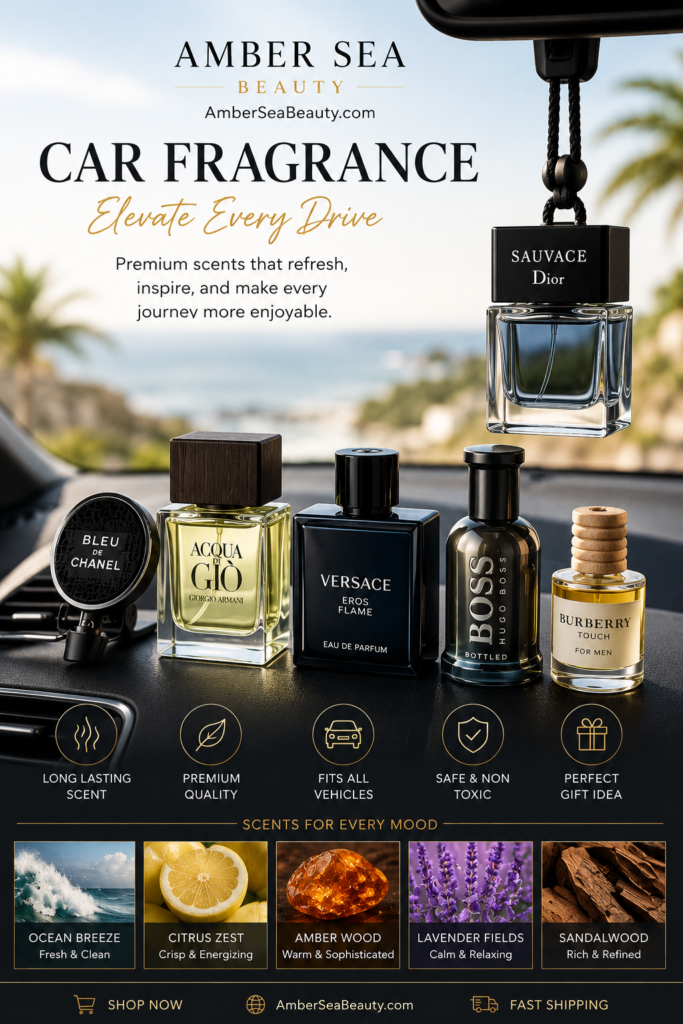
CATEGORY: Car Fragrance
Oil and bottle car fragrance diffusers offer a different experience from sprays, vent clips, hanging cards, gels, and solid air fresheners.
They are still designed to fragrance the vehicle cabin, but the delivery method is more decorative and often more gradual.
A typical product contains scented liquid inside a small bottle. The fragrance may diffuse through a wooden cap, porous stopper, wick, fiber element, or another absorbent material. Some bottles hang from a cord. Others sit inside holders, attach to vents, or remain secured in another suitable position.
The appeal is easy to understand.
A bottle diffuser can look more refined than a disposable card freshener.
It may resemble a small interior accessory rather than a conventional air freshener.
Many are refillable or designed around replaceable fragrance liquids.
And because the scent is released gradually, the cabin can develop a consistent fragrance rather than receiving the immediate burst produced by a spray.
But liquid fragrance introduces responsibilities that dry products do not.
The bottle must remain secure.
The liquid must stay contained.
The diffuser component should not become oversaturated.
Interior surfaces need protection from accidental spills.
Heat can accelerate evaporation.
And the product must never become a swinging object that distracts the driver or obstructs visibility.
Used correctly, oil and bottle diffusers can provide one of the most elegant forms of car fragrance.
Used carelessly, they can become messy, excessively strong, or potentially damaging to the interior.
Understanding the mechanism is therefore essential.
What Is a Car Bottle Diffuser?
A bottle diffuser is a small container holding scented liquid designed for gradual fragrance release inside a vehicle.
The bottle may be made from:
Glass.
Plastic.
Metal-lined material.
Another fragrance-resistant container.
The fragrance liquid usually contains aromatic compounds dissolved in a suitable carrier.
The product then uses some form of diffusion element.
Common examples include:
Wooden caps.
Porous cork-like stoppers.
Fiber reeds.
Wicks.
Absorbent inserts.
Vent-mounted porous materials.
The liquid moves into the absorbent component and gradually evaporates into the cabin.
The Bottle Is Only the Reservoir
It is useful to understand that the bottle itself does not usually release most of the fragrance directly.
Its primary role is storing the scented liquid.
The cap or absorbent component is often what creates the diffusion.
Liquid wets the porous material.
Fragrance evaporates from the exposed surface.
The cabin becomes scented.
This is why the condition of the cap or wick matters so much.
If it becomes too dry, scent may weaken.
If it becomes excessively saturated, the fragrance may become too strong or the product may leak.
Hanging Bottle Diffusers Are Especially Common
One of the most recognizable designs is a small bottle suspended from a cord.
The bottle often contains:
Scented oil.
A wooden stopper.
A decorative cap.
The cord may attach around:
A rear-view mirror.
Headrest support.
Interior hook.
Another suitable location.
The product is visually noticeable, which is part of its appeal.
It functions as both fragrance source and decorative accessory.
Not Every Hanging Location Is Appropriate
The most obvious location is not always the safest.
A hanging diffuser should never interfere with:
Driver visibility.
Mirrors.
Vehicle controls.
Airbags.
Gear selection.
Steering.
The product should also not swing so widely that it repeatedly strikes the dashboard or windscreen.
Local rules concerning objects hanging near the windscreen may also differ.
Safe placement matters more than tradition.
A Shorter Cord Usually Creates Better Control
Long cords allow a bottle to swing more dramatically.
That may look decorative when the vehicle is stationary.
During driving, however, excessive movement can become annoying.
Cornering.
Braking.
Acceleration.
Rough roads.
All increase movement.
A shorter secure attachment can reduce swinging while still allowing the diffuser to hang freely.
Glass Bottles Need Particular Care
Many premium-looking car diffusers use small glass bottles.
Glass can look elegant.
It also requires care.
A bottle should not repeatedly hit:
Dashboard trim.
Glass.
Hard plastic.
Metal controls.
If the bottle becomes cracked, chipped, or damaged, remove it immediately.
A damaged glass fragrance bottle should never remain inside a moving vehicle.
Liquid Diffusers Need More Care Than Dry Fresheners
A scented card cannot spill liquid.
A solid block cannot pour fragrance oil onto a console.
A bottle can.
This is the primary practical difference.
Liquid fragrance products should be treated as containers first and accessories second.
The seal must remain intact.
The stopper must remain correctly installed.
The bottle should remain in the orientation specified by the manufacturer.
Some Bottle Diffusers Need Occasional Tilting
Certain hanging bottle systems are designed so the user briefly tips the bottle upside down or at an angle.
This allows a small amount of fragrance liquid to wet the wooden cap.
The bottle is then returned upright.
The saturated cap gradually releases scent.
This should be done only according to the product instructions.
The aim is to moisten the diffuser.
Not soak it.
Too Much Tilting Can Cause Oversaturation
If the bottle is held upside down too long, the wooden cap may absorb excessive liquid.
This can cause:
Dripping.
Leakage.
Very strong fragrance.
Oil transfer onto the cord.
Staining on nearby surfaces.
Faster fragrance consumption.
A brief controlled tilt is normally sufficient when that is the intended design.
Never Leave a Bottle Intentionally Upside Down
Unless the manufacturer explicitly designed it to operate that way, a hanging fragrance bottle should generally return to its normal upright position after wetting the diffuser cap.
Leaving it inverted can overwhelm the absorbent material and increase the chance of leakage.
Continuous soaking is not the same as controlled diffusion.
Wooden Caps Are Popular Because Wood Is Naturally Porous
Wood can absorb small quantities of fragrance liquid.
This makes it well suited to gradual diffusion.
The cap may become visibly darker once saturated.
As the liquid evaporates, the wood gradually becomes drier.
The user may then refresh it according to the product instructions.
The exact frequency varies.
Heat.
Airflow.
Fragrance composition.
Cap size.
All affect performance.
Wooden Diffusers Can Also Look More Refined
Wood provides a decorative advantage.
Natural timber can suit:
Luxury interiors.
Minimalist cabins.
Leather upholstery.
Neutral color schemes.
Drivers who dislike bright disposable fresheners.
The diffuser can appear more like an interior accessory and less like a conventional air freshener.
Porous Stoppers Can Work Without Visible Tilting
Not every product uses the same mechanism.
Some bottle diffusers have a porous stopper that remains in contact with fragrance internally and gradually transports it outward.
Others use internal wicks.
Some contain membranes.
The correct operation depends entirely on the product design.
Never assume that one bottle diffuser should be used exactly like another.
Read the Specific Instructions Before Installation
This is particularly important with liquid products.
Check:
Whether the internal plastic stopper must be removed.
Whether the decorative cap must be replaced.
Whether the bottle should be tilted.
How long it should be tilted.
Where it may be installed.
Whether the product must remain upright.
Whether the bottle is refillable.
Using the product incorrectly can dramatically change both strength and safety.
Do Not Remove Seals Before You Understand the Product
Some bottle diffusers arrive with a sealing plug beneath the decorative cap.
The seal prevents leakage during transportation.
The normal setup may require:
Removing the cap.
Removing the transport stopper.
Reinstalling the diffuser cap.
But not every design is identical.
Follow the product sequence rather than improvising.
Oil Diffusers Can Produce a More Gradual Fragrance
Compared with sprays, bottle diffusers usually provide a slower fragrance experience.
The scent builds.
It does not necessarily explode into the cabin immediately.
This can create a more refined atmosphere.
The driver notices the fragrance when entering the car.
Then perception becomes softer during the journey.
For many users, this gradual release is one of the format’s greatest advantages.
Fragrance Strength Depends on How Wet the Diffuser Is
A freshly saturated wooden cap may smell strong.
As it dries, fragrance output becomes softer.
This creates a natural intensity cycle.
Immediately after refreshing:
Stronger.
Later:
More subtle.
Then:
Time to refresh again.
The user can learn how frequently the cap needs to be wetted to maintain the preferred intensity.
Small Cars Need Very Conservative Saturation
A compact car can become over-fragranced quickly.
If the bottle diffuser is too wet, the scent may become overwhelming.
Use the smallest amount necessary.
Allow the fragrance time to spread before refreshing again.
Do not assume that weak fragrance after two minutes means the diffuser needs more liquid.
Passive diffusion takes time.
Large Vehicles Can Require More Frequent Refreshing
In a larger SUV, van, or seven-seat vehicle, the same bottle may feel milder.
A larger cabin dilutes the fragrance.
The diffuser may need:
More exposed surface.
More frequent cap refresh.
More central placement.
This should still be adjusted gradually.
Placement Changes Perceived Strength
A bottle hanging directly in front of the driver will seem stronger than one positioned farther away.
A diffuser near an active vent may release fragrance faster.
A bottle hidden at the rear of a large vehicle may feel much weaker in the front.
Where the product sits matters almost as much as the fragrance itself.
Avoid Direct Contact With Dashboard Surfaces
The bottle should hang freely.
It should not rest against:
Dashboard plastic.
Leather.
Vinyl.
Wood trim.
Painted surfaces.
Touchscreens.
Fragrance oils can potentially mark, soften, stain, or discolor some materials.
Even if the bottle itself is sealed, a saturated wooden cap can transfer fragrance oil through contact.
Fragrance Oil and Interior Trim Can Be a Bad Combination
Vehicle materials vary considerably.
A liquid that causes no visible effect on one plastic may damage another.
The safest principle is simple:
Keep fragrance liquid off vehicle surfaces.
Do not wipe a leaking diffuser with the assumption that the oil is harmless.
If a spill occurs, remove the product and clean the area promptly using a method suitable for the specific material.
Leather Requires Particular Protection
Leather and synthetic leather can react poorly to inappropriate liquids.
Do not rub fragrance oil onto leather seats or trim.
A leather-scented fragrance is intended to smell like leather.
It does not mean the liquid is a leather-care product.
Fragrance and surface treatment are separate product categories.
Touchscreens Need Protection From Oil Mist and Drips
Modern vehicles often contain large displays.
Oily fragrance residue can create:
Smears.
Streaks.
Cleaning difficulty.
Potential coating damage depending on composition.
Keep liquid fragrance well away from electronic surfaces.
Steering and Control Surfaces Must Remain Clean
No oil diffuser should create residue on:
Steering wheel.
Gear selector.
Handbrake.
Touch controls.
Door handles.
Pedals.
Anything requiring reliable grip or precise operation should remain completely free from fragrance oils.
A Leaking Diffuser Should Be Removed Immediately
Do not try to tolerate a small leak.
A small leak can become a larger one.
Signs include:
Liquid around the bottle neck.
Wet cord.
Dripping cap.
Oil marks below the diffuser.
Unexpectedly intense fragrance.
Remove the product safely.
Inspect the bottle.
Clean any affected surfaces appropriately.
Heat Can Greatly Accelerate Oil Fragrance
Vehicle interiors can reach very high temperatures in direct sunlight.
Warmth increases evaporation.
A bottle diffuser that smells mild in the morning can become significantly stronger by afternoon.
Heat may also increase:
Liquid movement.
Cap saturation.
Pressure inside some containers.
Consumption rate.
This is why hot climates require especially cautious use.
Summer Can Shorten Fragrance Lifespan
A liquid diffuser may empty noticeably faster during hot weather.
The fragrance is constantly evaporating.
The wooden cap may need less frequent intentional wetting because the heat keeps diffusion active.
A product advertised to last a certain period may perform differently under extreme cabin temperatures.
Cold Weather Can Reduce Fragrance Release
In winter, evaporation may slow.
The diffuser may seem weaker.
Heating the cabin can make the fragrance more noticeable again.
Seasonal performance differences are normal.
Do not compensate immediately by saturating the cap heavily.
Strong Heater Air Can Accelerate Diffusion
If the bottle sits near warm airflow, fragrance release may increase.
This can be pleasant at low intensity.
Too much direct heat may consume the liquid rapidly.
Follow placement guidance and avoid deliberately heating the bottle to make it stronger.
Air-Conditioning Can Spread the Fragrance Throughout the Cabin
Even if the diffuser is not attached to a vent, the vehicle’s airflow helps distribute scent.
A small bottle can therefore fragrance a surprisingly large area once the climate system begins circulating air.
Give it time before deciding the product is too weak.
Oil Diffusers Work Best as Background Fragrance
The format is not usually intended to create the instant blast of a spray.
It is more suited to:
Continuous atmosphere.
A signature scent.
A decorative cabin fragrance.
Gradual release.
Drivers who want immediate heavy fragrance may prefer spray or stronger airflow-assisted vent products.
Citrus Oils Create a Bright Car Interior Atmosphere
Popular citrus fragrance directions include:
Bergamot.
Lemon.
Orange.
Mandarin.
Grapefruit.
Lime.
These can work particularly well in oil diffusers because the wooden cap softens the immediate impact.
The result can feel fresh rather than aggressively sharp.
Woody Fragrances Naturally Suit Bottle Diffusers
Wood fragrance paired with a wooden cap creates a visually and aromatically coherent product.
Popular profiles include:
Cedar.
Sandalwood.
Vetiver.
Dry woods.
Smoky timber.
These fragrances often feel more sophisticated than very sweet traditional air fresheners.
Leather and Wood Are a Natural Automotive Combination
Leather-inspired fragrance often combines beautifully with:
Cedar.
Sandalwood.
Amber.
Musk.
Smoky notes.
This creates a richer cabin atmosphere.
In darker or premium interiors, this fragrance direction can feel especially appropriate.
Amber Works Well in Slow Diffusion
Amber fragrances tend to be warm and deep.
When released gradually, they can create a more subtle luxury effect than a strong amber spray.
They may include:
Resins.
Vanilla.
Musk.
Woods.
Spices.
Because amber can become heavy, moderate diffusion is important.
Musk Can Produce a Clean or Sensual Effect
Musk is extremely versatile.
Clean musk may feel:
Fresh.
Soft.
Laundry-like.
Warm musk may feel:
Deeper.
More perfumed.
More luxurious.
A slow bottle diffuser can make musk feel smoother and less abrupt than a spray.
Vanilla Can Be Pleasant but Requires Control
Vanilla is naturally popular.
In an oil diffuser, it can become warm and persistent.
The problem is accumulation.
A small closed car can develop a very sweet atmosphere after several hours.
Use minimal cap saturation initially.
Vanilla and Wood Can Feel More Balanced Than Pure Sweet Vanilla
Blending vanilla with:
Sandalwood.
Cedar.
Amber.
Musk.
Leather.
Can reduce the dessert-like quality.
These combinations often feel more suitable for continuous automotive fragrance.
Marine Fragrance Can Work in Oil Format Too
Oil diffusers are not limited to deep fragrances.
Marine and aquatic profiles are also common.
Sea breeze.
Ocean air.
Ozone.
Watery notes.
Clean musk.
These create a fresher atmosphere and may suit warm climates particularly well.
Floral Oil Diffusers Can Be More Refined Than Traditional Floral Fresheners
Floral fragrance in a gradual diffuser may feel softer than a strong hanging card.
Popular directions include:
Lavender.
Rose.
Jasmine.
Peony.
Orange blossom.
White florals.
The blend determines whether the result feels delicate or intense.
Fruity Oils Need Careful Selection
Apple.
Cherry.
Berry.
Peach.
Mango.
Tropical fruit.
These can be enjoyable, but some become very sweet in enclosed cabins.
Fruit combined with:
Citrus.
Green notes.
Wood.
Musk.
Often feels more balanced for continuous use.
Gourmand Oil Diffusers Can Become Extremely Rich
Coffee.
Caramel.
Chocolate.
Coconut.
Vanilla dessert.
These are highly distinctive.
A slow diffuser can make them feel luxurious to someone who loves sweet scents.
To another person, they may become overwhelming.
They are best chosen deliberately rather than as a neutral default fragrance.
Bottle Diffusers Are Excellent for Signature Scents
Because the product releases fragrance gradually over long periods, it can establish a consistent cabin identity.
The driver begins associating the scent with the car.
A signature fragrance might be:
Leather and cedar.
Bergamot and musk.
Amber and sandalwood.
Marine and clean musk.
Vanilla and woods.
Consistency creates familiarity.
A Signature Scent Should Be Comfortable for Daily Use
A fragrance that impresses for five minutes may not work for a two-hour commute every day.
For signature use, prioritize:
Moderate strength.
Balanced composition.
No excessive sweetness.
No overwhelming sharpness.
A scent that remains pleasant over extended exposure.
Bottle Diffusers Can Be Better Than Hanging Cards for Appearance
A traditional card freshener is obviously functional.
A small decorative bottle may appear more refined.
Some products feature:
Clear glass.
Amber glass.
Wooden caps.
Black caps.
Metal accents.
Minimal labels.
Decorative cords.
This makes them attractive to drivers who care about interior aesthetics.
Decorative Appeal Should Never Override Safety
A beautiful glass bottle is still a moving object.
If it:
Blocks the view.
Swings excessively.
Hits controls.
Leaks.
It is badly installed.
Safe use comes first.
Vent-Mounted Oil Diffusers Offer Another Format
Some oil fragrance systems use small fragrance reservoirs attached to the vent.
Instead of hanging, they remain fixed.
Airflow passes around the fragrance element.
This combines:
Oil fragrance.
Vent diffusion.
Compact mounting.
The experience may be stronger than a passive hanging bottle because air is actively moving across the fragrance.
Vent-Mounted Oil Products Need Leak-Proof Design
A liquid product mounted on a dashboard vent must remain secure.
If it leaks, fragrance may contact:
Vent plastic.
Dashboard.
Electronic controls.
The unit should be removed immediately if any liquid escapes.
Do Not Refill a Diffuser With Random Liquids
A refillable bottle can tempt users to experiment.
Personal perfume.
Essential oils.
Home diffuser liquids.
Mixed fragrance oils.
But not every liquid is suitable for an automotive diffuser.
Different liquids have different:
Viscosity.
Evaporation rates.
Solvents.
Material compatibility.
Use fragrance specifically intended for the diffuser system.
Essential Oils Are Not Automatically Interchangeable With Car Fragrance Oils
The term “oil” can create confusion.
A manufactured car fragrance oil and a concentrated essential oil are not necessarily the same thing.
They may have different safety instructions, concentration, and material compatibility.
A diffuser should be filled only with products recommended for it.
Refillable Systems Can Be Economical
Once a reusable bottle and cap are purchased, the user may only need replacement fragrance liquid.
This can reduce repeated purchase of disposable holders.
It also allows scent changes without replacing the decorative accessory.
The actual economy depends on:
Refill price.
Bottle size.
Evaporation rate.
How often the cap is saturated.
Climate.
Refillability Can Also Increase Scent Variety
A reusable bottle may allow the driver to alternate among compatible scents.
Summer:
Citrus or marine.
Autumn:
Wood.
Winter:
Amber or leather.
Spring:
Green or floral.
This can make the product more versatile than a sealed disposable diffuser.
The Bottle Should Be Clean Before Refilling
When switching fragrance, residual scent from the previous liquid can affect the new one.
If the system is designed for cleaning and refilling, follow the manufacturer’s method.
Do not improvise aggressive solvents or cleaning agents.
Some bottles and caps may not be intended for repeated fragrance switching.
Wooden Caps Can Retain Old Fragrance
Even if the bottle is cleaned, the cap may still contain the previous scent.
This can create a mixed fragrance.
For completely different scent families, replacing the porous element may provide a cleaner transition where compatible replacements exist.
Refilling Too High Can Increase Leakage Risk
Leave the fill level recommended by the manufacturer.
An overfilled bottle provides less empty space.
Liquid may reach the stopper too easily.
Vehicle movement can push fragrance toward the opening.
More liquid does not necessarily improve diffusion.
Never Fill Beyond the Intended Capacity
The bottle’s decorative size does not mean every millimeter should contain fragrance.
Proper headspace can be part of safe operation.
Follow fill guidance.
Bottle Diffusers Are Less Suitable for Rough-Use Vehicles
A hanging glass diffuser may not be ideal in every environment.
Vehicles used for:
Off-road driving.
Construction work.
Very rough roads.
Frequent cargo loading.
May benefit from a more secure gel, solid, or vent-based product.
The fragrance format should match vehicle use.
Family Vehicles May Need More Secure Placement
Children may reach for hanging decorative bottles.
They may pull cords.
Open containers.
Tilt them repeatedly.
A liquid diffuser should remain out of reach.
A hidden gel or vent product may be more practical in some family cars.
Pet Vehicles Require Similar Caution
A dog may:
Sniff.
Lick.
Chew.
Pull.
A hanging bottle positioned near the rear seats could become accessible.
Choose a location where animals cannot reach it.
Lower fragrance intensity may also be preferable.
Professional Vehicles Benefit From Subtle Diffusion
A bottle diffuser can look refined in a vehicle used for:
Client transport.
Private hire.
Business travel.
But the scent should remain restrained.
Passengers have different preferences.
A clean woody, citrus, marine, or musk fragrance is often easier to tolerate than very strong sweet compositions.
Strong Fragrance Can Create Passenger Discomfort
The driver may become accustomed to the scent.
A passenger entering for the first time experiences it at full intensity.
This difference is important.
If other people use the car regularly, ask for feedback.
The product may be much stronger than it seems to you.
Nose Adaptation Occurs With Oil Diffusers Too
Continuous exposure reduces perception.
After several days, the driver may think the fragrance has weakened.
It may still be clearly noticeable to others.
Do not saturate the cap repeatedly simply because your own nose has adapted.
Check Strength After Time Away From the Car
Leave the vehicle for several hours.
Return.
Notice the first impression.
This gives a better sense of actual fragrance level.
If the scent is still strong when entering, the diffuser is working.
Over-Saturating the Cap Wastes Product
Frequent tilting can consume fragrance rapidly.
It may also keep the cabin constantly over-perfumed.
Allow the cap to diffuse naturally.
Refresh only when necessary.
The Bottle Should Not Be Treated Like a Shaker
Repeatedly turning the bottle over every journey is often unnecessary unless the instructions specifically say otherwise.
The cap can retain fragrance for some time.
Learn the actual performance before developing a routine.
Strong Fragrance Immediately After Tilting Is Normal
A newly wetted cap may release a strong scent.
This should soften gradually.
If it remains overwhelming for hours, less liquid should be applied next time.
Ventilation Can Reduce Excessive Scent
If too much fragrance has been released:
Open windows.
Open doors.
Increase fresh-air ventilation.
Remove the diffuser temporarily if necessary.
Do not add another scent in an attempt to balance it.
Oil Diffusers Do Not Replace Cleaning
A sophisticated-looking bottle does not solve:
Smoke odor.
Damp carpets.
Food residue.
Pet smells.
Mold.
Dirty upholstery.
A fragrance product adds scent.
It does not automatically remove the cause of an unpleasant odor.
Clean the Cabin Before Creating a Signature Fragrance
The best result comes from a clean base.
Remove rubbish.
Vacuum.
Clean mats.
Address stains.
Ventilate.
Investigate persistent odors.
Then install the diffuser.
The fragrance will smell clearer and more intentional.
Interior Cleaning Products Can Affect the Final Scent
Many dashboard, leather, carpet, and upholstery products already contain fragrance.
A strongly scented cleaner may compete with the oil diffuser.
If you want the diffuser to dominate, choose neutral or lightly scented cleaning products where suitable.
Matching Fragrance Families Can Create Cohesion
If the leather cleaner has a mild leather aroma, a leather-wood diffuser may complement it.
If the cabin cleaner smells citrus, a bergamot diffuser may work well.
The aim is not complicated fragrance layering.
It is avoiding obvious conflict.
Oil Diffusers Usually Last Longer Than Individual Spray Applications
A spray gives a temporary fragrance event.
An oil bottle continuously stores fragrance for future diffusion.
This can create a longer-lasting overall system.
But the exact lifespan depends on usage.
A bottle frequently tilted in hot weather may empty quickly.
A conservatively used bottle in moderate conditions may last much longer.
Product Duration Claims Are Only Estimates
Actual performance varies according to:
Bottle capacity.
Cap design.
Temperature.
Humidity.
Airflow.
Parking conditions.
Vehicle size.
Use frequency.
A manufacturer’s estimate is useful but not an exact prediction.
Visible Liquid Level Makes Consumption Easy to Monitor
One advantage of clear or translucent bottle designs is that the user can see how much fragrance remains.
This makes replacement planning easier.
It can also reveal unexpectedly rapid consumption.
If the bottle empties much faster than expected, check for:
Leakage.
Over-saturation.
Excessive heat.
Incorrect positioning.
An Unexpected Drop in Liquid Level Can Signal a Problem
If half the bottle disappears suddenly, do not assume it simply evaporated overnight.
Inspect:
Cap.
Neck.
Cord.
Nearby surfaces.
A leak may have occurred.
Oil Diffusers Often Cost More Than Basic Hanging Cards
The decorative bottle and refill system can increase the purchase price.
However, the product may offer:
Longer use.
Refillability.
Better appearance.
More complex fragrance.
Whether this provides better value depends on the buyer.
Premium Appearance Is Part of the Product Value
With bottle diffusers, buyers are often purchasing two things:
Fragrance.
Accessory design.
A plain scented card may deliver fragrance for less money.
A glass bottle with a wooden cap may simply be more enjoyable to look at.
That aesthetic value is legitimate if it matters to the buyer.
Choose the Product According to Priorities
If the priority is lowest cost:
Hanging card may win.
If the priority is maximum control:
Spray may win.
If the priority is automatic airflow diffusion:
Vent clip may win.
If the priority is hidden low-maintenance fragrance:
Gel or solid may win.
If the priority is decorative slow fragrance:
Oil bottle diffuser is especially strong.
Oil Diffusers Suit Drivers Who Enjoy Fragrance as Part of the Interior
This format is not only functional.
The bottle can become part of the vehicle’s character.
The fragrance can become a signature.
The user interacts with the product occasionally by refreshing or refilling it.
That makes it more personal than a disposable freshener.
They Are Less Suitable for Drivers Who Want Zero Maintenance
A bottle diffuser may require:
Checking liquid.
Tilting.
Refilling.
Inspecting for leaks.
Maintaining placement.
A gel or solid product may be easier if you want to forget the fragrance source completely.
They Are Also Less Suitable for People Who Dislike Visible Accessories
Even a small bottle remains visible if hanging near the front cabin.
If you prefer a completely clean visual interior, choose:
Hidden gel.
Solid insert.
Small vent fragrance.
Occasional spray.
Aesthetic preference matters.
Choosing the Right Bottle Diffuser
Before purchasing, consider:
Is it hanging or fixed?
Is the bottle glass or plastic?
Does it require tilting?
Is it refillable?
Are compatible refills easy to obtain?
Is the cap replaceable?
How strong is the fragrance?
Where will the bottle hang?
Can children or pets reach it?
How hot does the car become?
Does the design suit the interior?
Choose the Scent After Confirming the Format Works for Your Car
It is easy to buy a beautiful fragrance and later discover the bottle swings constantly or cannot be installed safely.
Check practicality first.
Then choose fragrance.
Start With a Moderate Fragrance Family
If you have never used an oil car diffuser, a versatile scent is a sensible starting point.
Examples might include:
Fresh citrus.
Woody citrus.
Clean musk.
Marine.
Light leather and wood.
These are often easier to live with than extremely sweet or intense fragrance.
Begin With Minimal Cap Saturation
This is the most important practical rule.
Less first.
More later if necessary.
The cabin is small.
The liquid is concentrated.
The fragrance has time to build.
Give the Diffuser Several Hours Before Judging Strength
Do not wet the cap repeatedly within the first few minutes because the scent seems weak.
Allow the fragrance to diffuse.
Drive normally.
Leave the vehicle closed for a while.
Then reassess.
Oil and Bottle Diffusers Are About Controlled Slow Release
The format works best when it is allowed to behave as designed.
Reservoir.
Absorbent material.
Gradual evaporation.
That is the system.
Trying to force maximum output usually reduces the advantages.
A Good Bottle Diffuser Should Smell Refined, Not Wet
If the cabin smells overwhelmingly of raw fragrance liquid, too much has probably been released.
The ideal result is a smooth background scent.
The product should not smell as though the bottle has spilled.
The Best Diffuser Becomes Part of the Car Without Demanding Attention
It hangs securely or remains fixed.
The bottle does not leak.
The cap releases fragrance gradually.
The scent stays comfortable.
The design complements the interior.
The driver refreshes it occasionally.
That is all.
Oil Car Fragrance Combines Product Design With Scent Experience
This is what makes the category distinct.
A spray is mainly about fragrance.
A gel is mainly about convenience.
A bottle diffuser adds a decorative dimension.
The reservoir, cap, cord, glass, wood, and fragrance work together as one small interior accessory.
For buyers who enjoy that combination, the format can feel more premium and personal than traditional air fresheners.
Safety and Restraint Create the Best Result
Keep the bottle secure.
Protect vehicle surfaces.
Follow the installation instructions.
Do not overfill.
Do not oversaturate.
Do not allow excessive swinging.
Keep it away from children and pets.
Adjust for heat.
Clean leaks immediately.
Use only compatible fragrance liquids.
These simple habits prevent most practical problems.
Oil and Bottle Car Fragrance Diffusers Are Best for Drivers Who Want Continuous Scent With More Character
They offer something different from the disposable formats.
A little more presentation.
A little more involvement.
Potential refillability.
Gradual fragrance.
A visible accessory that can complement the cabin.
They are not necessarily the easiest option.
They are not automatically the strongest.
They are not automatically the longest-lasting.
Their appeal lies in the combination of slow scent release and decorative design.
When the bottle is secure, the fragrance is properly controlled, and the scent suits the vehicle, the diffuser can provide a subtle atmosphere every time the door opens.
Not a sudden cloud of perfume.
Not a bright disposable card demanding attention.
Just a steady fragrance quietly becoming part of the car itself.
The End
AmberSeaBeauty.com
 Discover More From Our Family of Websites
 ZodiacBearing (Astrology, Tarot, Numerology, Angel Numbers & Spiritual Guidance)
 Velourana (Beauty, Makeup, Hair Care, Skincare & Beauty Tips)
 HavenBearing (Home, Living, Organization, Décor & Everyday Inspiration)
 PawBearing (Pet Care, Dog Breeds, Animal Health, Training & Pet Products)
 PsyCatherine (Notes From the Journal of a Psychologist on Real Life)