CATEGORY: Conditioners
Many people think of conditioner as the final step of washing their hair. Once it has been rinsed away, they assume the conditioning process is complete until the next shampoo. However, modern hair care has introduced another highly effective category of products that continues working long after washing has finished: the leave-in conditioner.
Unlike traditional rinse-out conditioners, leave-in conditioners remain on the hair throughout the day, providing continuous hydration, improving manageability, reducing friction, and helping protect the hair from environmental stress and everyday styling. They have become an essential product for many people, particularly those with dry, curly, long, colour-treated, or frequently styled hair.
Despite their growing popularity, leave-in conditioners are often misunderstood. Some believe they replace regular conditioners, while others worry they may make hair greasy or heavy. In reality, when chosen correctly and applied properly, a leave-in conditioner serves as an additional layer of care that complements—not replaces—the rest of a healthy hair care routine.
What Is a Leave-In Conditioner?
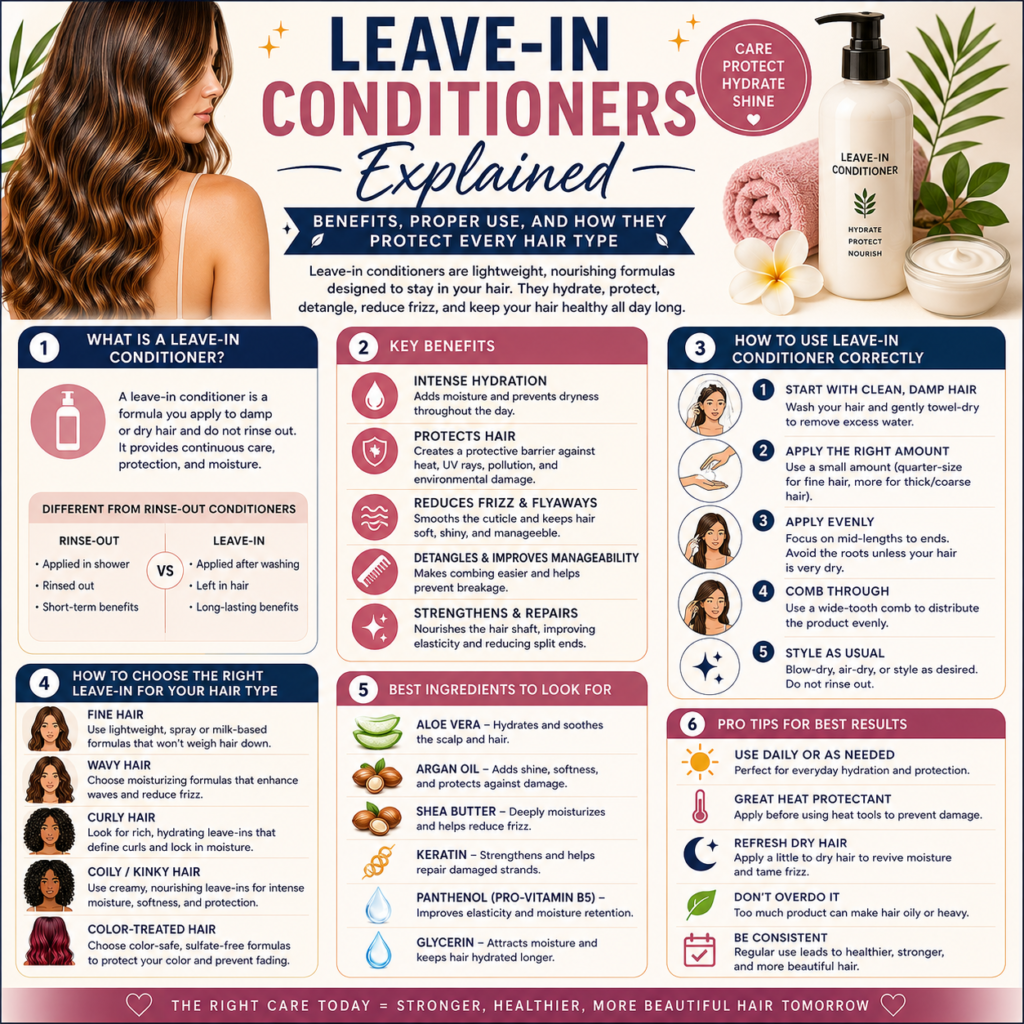
A leave-in conditioner is a lightweight conditioning product designed to remain on the hair after washing. Instead of being rinsed away after several minutes, it stays on the hair throughout the day, allowing conditioning ingredients to continue protecting and softening the hair fibre.
Because these products remain on the hair for many hours, their formulations differ significantly from traditional conditioners. They are generally lighter in texture while still providing hydration, lubrication, and improved manageability.
Rather than coating the hair heavily, most quality leave-in conditioners create an invisible protective layer that supports the hair during brushing, styling, and everyday environmental exposure.
Why Hair Benefits from Continuous Conditioning
Hair is constantly exposed to conditions that gradually weaken its protective outer layer.
Everyday brushing creates friction. Wind tangles the strands. Ultraviolet radiation dries the hair surface. Indoor heating and air conditioning reduce moisture levels, while humidity can increase frizz by disrupting the cuticle.
Traditional conditioner helps prepare the hair after washing, but a leave-in conditioner continues supporting the hair throughout these daily challenges.
This ongoing protection is particularly valuable for people whose hair regularly experiences mechanical or environmental stress.
The Main Benefits of Leave-In Conditioners
One of the reasons leave-in conditioners have become increasingly popular is that they provide multiple benefits simultaneously.
Improved Hydration
Leave-in conditioners help reduce moisture loss between washes. By maintaining better hydration throughout the day, the hair often feels softer, smoother, and more flexible.
This is especially helpful for naturally dry or curly hair, which tends to lose moisture more quickly than straight hair.
Easier Detangling
Few things contribute to hair breakage more than aggressively pulling a brush through tangled strands.
Leave-in conditioners reduce friction, allowing knots to separate more easily. This results in gentler brushing and less unnecessary stress on the hair shaft.
Long hair particularly benefits from improved detangling because the ends have experienced years of daily wear.
Frizz Control
Frizz develops when the outer cuticle becomes uneven or when hair repeatedly gains and loses moisture from the surrounding environment.
By smoothing the surface of each strand, leave-in conditioners help reduce flyaways while improving the overall appearance of the hair.
Rather than forcing the hair into an unnatural shape, they encourage smoother movement while maintaining the hair’s natural texture.
Enhanced Shine
Smooth hair reflects light more evenly than rough hair.
Because leave-in conditioners help align the outer cuticle, they often improve natural shine without requiring heavy styling products or oils.
Healthy-looking shine generally develops from smoother hair rather than from excessive product.
Protection During Styling
Styling places considerable stress on the hair, particularly when heat is involved.
Hair dryers, straighteners, curling irons, and heated brushes all increase moisture loss during use.
Many leave-in conditioners include ingredients that reduce friction during styling while helping prepare the hair before additional heat protectants are applied.
Although leave-in conditioners should not automatically be considered replacements for dedicated heat protection products, they often provide valuable support within an overall styling routine.
Who Benefits Most from Leave-In Conditioners?
While almost anyone can use a leave-in conditioner, some hair types typically notice greater improvements.
Curly Hair
Natural curls benefit greatly from continuous moisture because their structure makes it more difficult for scalp oils to travel from the roots to the ends.
Leave-in conditioners help curls remain softer, more defined, and easier to manage between washes.
Colour-Treated Hair
Chemical colouring temporarily alters the hair structure, increasing the need for regular conditioning.
Leave-in products help maintain softness while reducing dryness commonly associated with repeated colouring.
Fine Hair
People with fine hair often hesitate to use leave-in conditioners because they fear losing volume.
Fortunately, many modern formulas are specifically designed for fine hair, providing hydration without excessive weight.
Selecting a lightweight spray or milk formulation often delivers the best balance.
Mature Hair
As hair ages, it frequently becomes drier and more fragile.
Daily conditioning support can improve flexibility while making brushing more comfortable and reducing mechanical breakage.
How to Apply Leave-In Conditioner Correctly
Proper application is just as important as choosing the right product.
After washing and conditioning the hair, gently remove excess water using a soft towel.
Apply a moderate amount of leave-in conditioner mainly to the mid-lengths and ends, where dryness is usually greatest.
Using a wide-tooth comb helps distribute the product evenly throughout the hair.
Unless specifically instructed by the manufacturer, excessive application directly onto the scalp is generally unnecessary.
The goal is even distribution rather than saturation.
Choosing the Right Formula
Leave-in conditioners are available in several forms.
Sprays
Lightweight spray conditioners are often preferred for fine or straight hair because they provide moisture without reducing natural movement.
Creams
Cream formulations are richer and usually better suited to thicker, curly, or very dry hair.
Milks
Hair milks provide a balance between sprays and creams, making them suitable for many hair types seeking moderate hydration.
Selecting the appropriate texture often has a greater impact on results than choosing products based solely on advertising claims.
Common Mistakes to Avoid
Many disappointing experiences occur because of incorrect application rather than poor-quality products.
Using excessive amounts may cause hair to appear heavy or greasy.
Applying products unevenly can leave some sections dry while over-conditioning others.
Some users mistakenly replace regular rinse-out conditioner with leave-in products, but both serve different purposes and generally work best together.
Consistency and moderation usually produce better long-term results than excessive product use.
Incorporating Leave-In Conditioner into a Complete Routine
Leave-in conditioner should be viewed as one component of a balanced hair care routine.
Gentle cleansing, regular conditioning, occasional deep conditioning, appropriate heat protection, careful brushing, and routine trimming all work together to support healthier-looking hair.
Rather than relying on a single product to solve every concern, combining these practices provides more reliable and lasting improvements.
Hair responds best when care remains consistent over time.
Final Thoughts
Leave-in conditioners have earned their place within modern hair care because they extend the protective benefits of conditioning well beyond the shower. By continuously reducing friction, improving hydration, controlling frizz, and supporting easier styling, they help preserve the comfort and appearance of the hair throughout everyday life.
Whether your hair is straight, curly, thick, fine, coloured, or naturally dry, selecting a leave-in conditioner suited to your individual needs can become one of the simplest yet most effective additions to your routine. Used alongside regular conditioning and gentle hair care habits, it contributes to softer, shinier, and more manageable hair while helping reduce the cumulative effects of daily wear.
The End
AMBERSEABEAUTY.COM
 Discover More From Our Family of Websites
 ZodiacBearing (Astrology, Tarot, Numerology, Angel Numbers & Spiritual Guidance)
 Velourana (Beauty, Makeup, Hair Care, Skincare & Beauty Tips)
 HavenBearing (Home, Living, Organization, Décor & Everyday Inspiration)
 PawBearing (Pet Care, Dog Breeds, Animal Health, Training & Pet Products)
 PsyCatherine (Notes From the Journal of a Psychologist on Real Life)