CATEGORY: Conditioners
Choosing the right conditioner is only part of achieving healthy-looking hair. Equally important is understanding how to use it correctly, how often it should be applied, and how it fits into an overall hair care routine. Over the years, countless myths, conflicting advice, and marketing claims have created confusion for consumers trying to care for their hair properly.
Some people worry that conditioners make hair greasy, while others believe they repair split ends or permanently restore damaged hair. Many are uncertain whether expensive conditioners are always better than affordable alternatives or whether they should switch products regularly.
This guide brings together the questions that hair professionals hear most often and provides balanced, evidence-based explanations to help you better understand one of the most important products in modern hair care.
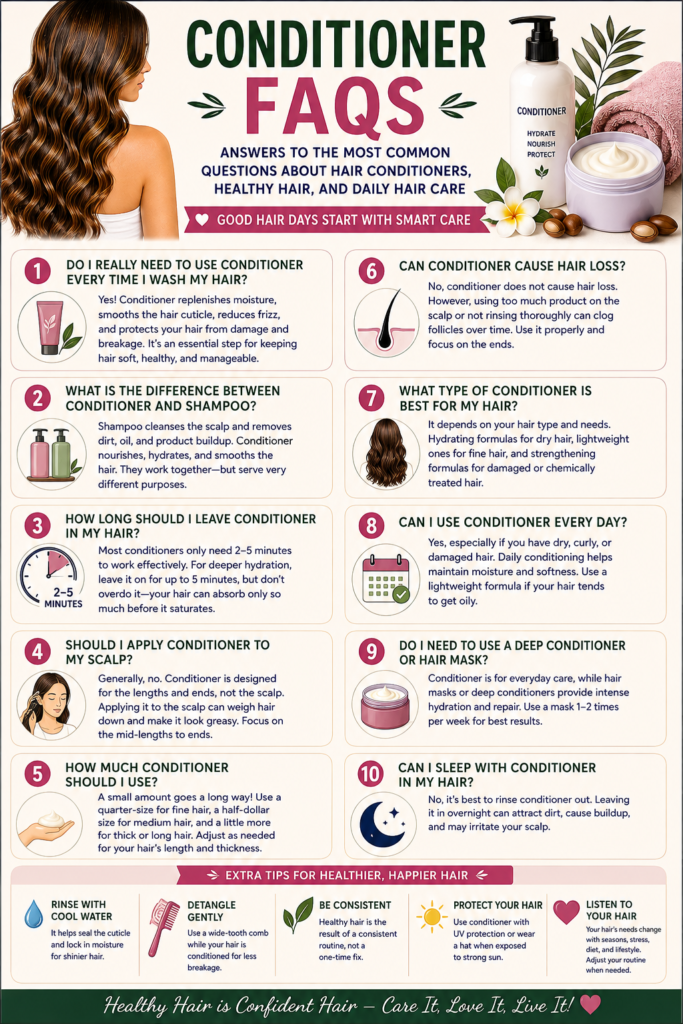
Does Everyone Need Conditioner?
For most people, the answer is yes.
Shampoo cleanses the hair by removing excess oil, dirt, perspiration, pollution, and styling product residue. During this cleansing process, the outer cuticle of the hair temporarily becomes more exposed. Conditioner helps smooth this surface again, reducing friction between individual strands and making the hair easier to comb and style.
Even people with naturally healthy hair usually benefit from regular conditioning because it helps protect the hair from the cumulative effects of daily brushing, washing, and environmental exposure.
Can Conditioner Repair Damaged Hair?
This is one of the most common misconceptions.
Hair that has grown beyond the scalp is no longer living tissue. Once it becomes chemically or mechanically damaged, no cosmetic product can permanently repair it.
Conditioners improve the appearance and feel of damaged hair by smoothing the cuticle, increasing softness, reducing tangles, and helping minimise further breakage. They make damaged hair look healthier and behave more comfortably, but they do not permanently rebuild the hair fibre.
Regular trimming remains the only permanent solution for removing severely damaged ends.
Is More Conditioner Better?
Not necessarily.
Applying excessive amounts of conditioner does not automatically produce softer or healthier hair.
Most modern conditioners are carefully formulated to perform effectively using moderate quantities. Excess product may simply remain on the surface of the hair, leaving it heavier than necessary and sometimes making styling more difficult.
Using the correct amount according to hair length and thickness usually produces the most natural results.
Should Conditioner Be Applied to the Scalp?
For most traditional conditioners, the answer is generally no.
The scalp naturally produces sebum, an oil that helps lubricate the hair near its roots. The oldest and driest sections of the hair are usually the mid-lengths and ends.
Applying conditioner primarily where moisture is needed allows the product to perform more effectively while helping preserve natural volume.
Some specialised scalp-conditioning products are designed specifically for direct scalp application, but these differ from ordinary rinse-out conditioners.
Can Conditioner Cause Hair Loss?
This concern appears frequently, yet ordinary conditioners do not normally cause hair loss.
It is common to notice hairs in the shower while rinsing conditioner, but these strands usually completed their natural growth cycle before washing began. Because conditioner improves slip between strands, naturally shed hairs are often released during rinsing, creating the impression that the conditioner caused them to fall out.
The conditioner itself is not responsible for the natural shedding process.
Should You Change Conditioners Regularly?
Many people believe hair becomes “used to” a conditioner over time.
In reality, the hair does not develop tolerance in the same way that living tissue responds to certain medications.
However, your hair’s needs often change.
Seasonal weather, colouring, increased heat styling, changes in hair length, or ageing may all influence the type of conditioner that feels most suitable.
Changing products because your hair has changed makes sense. Changing them simply because you have used one bottle completely is usually unnecessary.
Are Expensive Conditioners Always Better?
Price alone does not determine quality.
Premium conditioners may contain highly refined ingredients, luxurious fragrances, elegant packaging, or advanced formulations, but many affordable products also provide excellent conditioning performance.
The best conditioner is the one that suits your individual hair rather than the one carrying the highest price tag.
Understanding ingredients and selecting products according to your hair type often proves more valuable than focusing exclusively on cost.
Should You Comb Conditioner Through the Hair?
Many professionals recommend distributing conditioner evenly with either the fingers or a wide-tooth comb.
This helps ensure that every section of the hair receives similar coverage while gently removing tangles.
Aggressive brushing while the hair is wet should be avoided because wet hair stretches more easily and may become vulnerable to unnecessary breakage.
Gentle handling remains one of the simplest ways to preserve healthy-looking hair.
Can Conditioner Replace Heat Protection?
No.
Although many conditioners improve softness and reduce friction, they should not automatically be considered substitutes for dedicated heat protectant products.
High temperatures produced by straighteners, curling irons, and blow dryers expose the hair to stresses that require specialised protective formulations.
Conditioner supports healthy hair, but heat protection remains an important additional step whenever elevated temperatures are used.
Is It Safe to Leave Conditioner on Longer Than Recommended?
Many people believe leaving conditioner on for extended periods dramatically improves its performance.
Most conditioners are formulated to work within the time specified by the manufacturer.
Allowing the product to remain on the hair for a few extra minutes is generally unlikely to cause problems, but leaving ordinary rinse-out conditioner on for exceptionally long periods rarely provides significant additional benefit.
Products specifically designed as overnight treatments should always be used according to their own directions.
How Can You Tell If a Conditioner Is Working?
The effects of a suitable conditioner usually become apparent through everyday experience.
Hair often becomes easier to comb, softer to the touch, smoother during styling, and more resistant to tangling.
Natural shine may improve as the cuticle becomes smoother, while frizz often becomes easier to manage.
These changes usually develop through consistent use rather than dramatic overnight transformation.
Building Confidence in Your Hair Care Routine
Hair care does not need to become complicated.
Understanding the purpose of each product, observing how your own hair responds, and making thoughtful adjustments over time generally produces better results than constantly chasing the latest trends.
Healthy-looking hair is usually the result of consistency rather than perfection.
Regular conditioning, gentle washing, sensible styling practices, occasional deep treatments when needed, and realistic expectations together create a routine that supports the hair through every season and every stage of life.
Final Thoughts
Conditioners remain one of the most valuable products in modern hair care because they support the hair in countless everyday situations. They improve softness, reduce friction, enhance manageability, and help protect the hair from the gradual wear caused by washing, brushing, styling, and environmental exposure.
Understanding how conditioners work—and separating common myths from scientific reality—allows you to make more informed decisions about your own hair. Whether your hair is straight, curly, fine, thick, colour-treated, or naturally dry, thoughtful conditioning remains one of the simplest and most effective ways to maintain healthier-looking, more comfortable, and beautifully manageable hair for years to come.
The End
AMBERSEABEAUTY.COM
 Discover More From Our Family of Websites
 ZodiacBearing (Astrology, Tarot, Numerology, Angel Numbers & Spiritual Guidance)
 Velourana (Beauty, Makeup, Hair Care, Skincare & Beauty Tips)
 HavenBearing (Home, Living, Organization, Décor & Everyday Inspiration)
 PawBearing (Pet Care, Dog Breeds, Animal Health, Training & Pet Products)
 PsyCatherine (Notes From the Journal of a Psychologist on Real Life)