CATEGORY: Conditioners
Standing in front of the hair care aisle can quickly become overwhelming. Shelves are filled with conditioners promising intense hydration, professional repair, brilliant shine, anti-frizz technology, botanical nourishment, protein reconstruction, and salon-quality results. Yet when you turn the bottle around to read the ingredient list, you are often greeted by unfamiliar scientific names that reveal very little about how the product actually works.
Understanding conditioner ingredients is one of the most valuable skills any consumer can develop. Rather than choosing products based solely on attractive packaging or marketing claims, learning the purpose of the major ingredient groups allows you to select formulas that genuinely match your hair’s needs.
Every conditioner is carefully designed to perform specific functions. Some ingredients attract moisture, others soften the hair, some strengthen weakened fibres, while others improve shine or reduce friction during brushing. None of these ingredients works in isolation; instead, they operate together to create a balanced conditioning system.
Why Ingredient Knowledge Matters
Hair care is highly personal. Two people using the same conditioner may experience completely different results because their hair differs in texture, density, porosity, chemical history, and environmental exposure.
An ingredient that transforms one person’s dry curls may leave another person’s fine straight hair feeling heavy. Likewise, a lightweight conditioner perfect for naturally oily hair may not provide sufficient nourishment for chemically treated or mature hair.
Understanding ingredient functions makes it easier to evaluate products objectively rather than relying entirely on advertising language.
Water: The Foundation of Every Conditioner
Nearly every conditioner begins with water.
Water acts as the carrier that allows conditioning ingredients to spread evenly throughout the hair during application. It provides the product with its smooth texture while helping distribute moisturising and protective ingredients across each strand.
Although water itself does not permanently hydrate hair, it serves as the essential base upon which the entire conditioner is formulated.
Emollients: Restoring Softness
One of the largest groups of conditioning ingredients consists of emollients.
Emollients help soften the surface of the hair by filling microscopic irregularities along the cuticle. This smoother surface reduces friction, allowing strands to glide more easily against one another.
Hair that feels silky after conditioning has often benefited from carefully balanced emollient ingredients.
Natural oils, plant butters, fatty alcohols, and specialised conditioning esters all belong to this broad category.
Humectants: Attracting Moisture
Humectants perform a different role.
Rather than coating the hair, they attract and retain moisture from the surrounding environment when conditions allow.
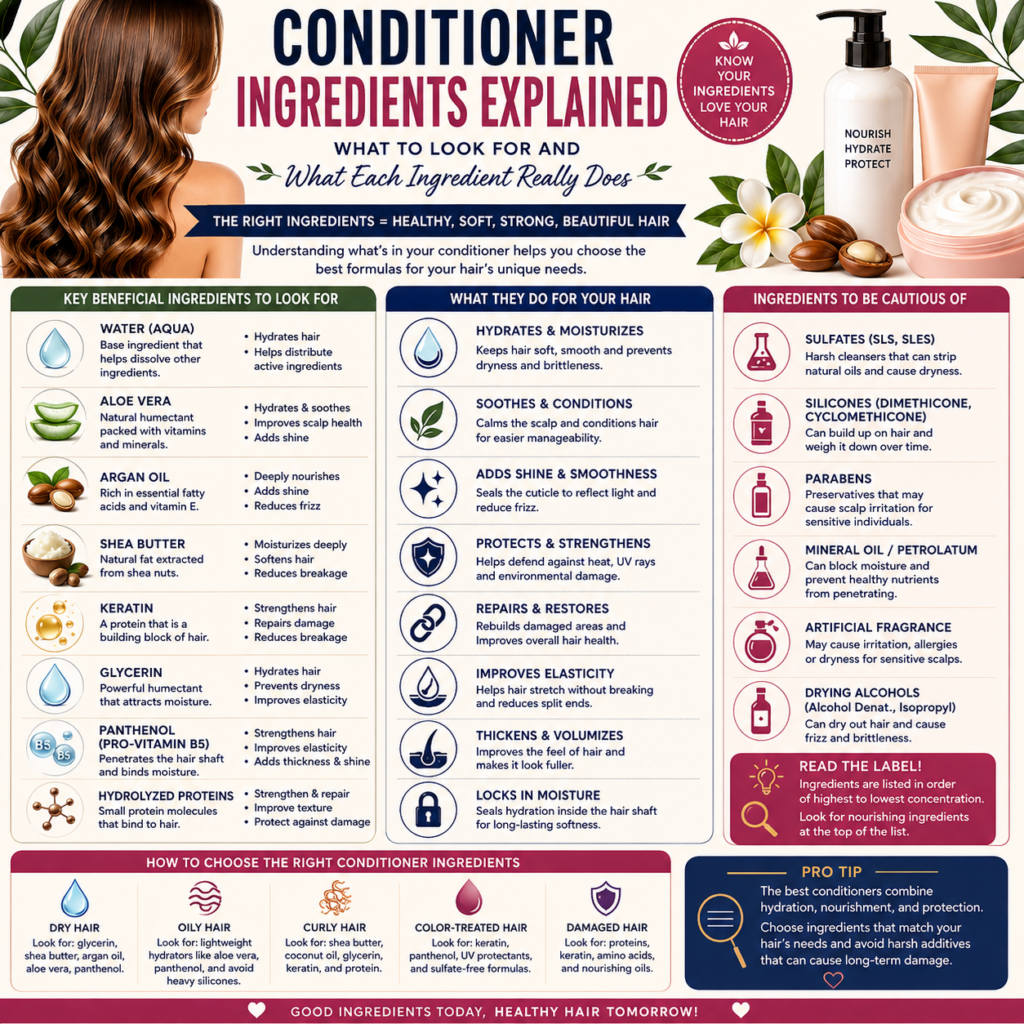
Among the most widely used humectants are glycerin and panthenol, both recognised for their ability to support improved hydration.
Humectants help increase flexibility within the hair fibre, reducing the dry, brittle feeling that often develops after repeated washing or environmental exposure.
Fatty Alcohols: Not the Alcohols You Should Fear
Many consumers become concerned whenever they see the word “alcohol” on a cosmetic label.
However, not all alcohols behave the same way.
Drying Alcohols
Some short-chain alcohols evaporate rapidly and are primarily used in styling products rather than rich conditioners.
Fatty Alcohols
Ingredients such as cetyl alcohol, cetearyl alcohol, and stearyl alcohol are entirely different.
These fatty alcohols provide creaminess, improve softness, stabilise the formulation, and contribute significantly to the luxurious feel of quality conditioners.
Far from drying the hair, they are considered highly beneficial conditioning ingredients.
Natural Oils
Plant oils have been used in hair care for centuries because they improve lubrication while helping reduce moisture loss.
Common examples include argan oil, coconut oil, jojoba oil, avocado oil, olive oil, and sweet almond oil.
Each oil has its own unique composition, but collectively they contribute to smoother, softer, and more manageable hair.
Modern formulations typically combine several oils in carefully balanced proportions rather than relying on a single ingredient.
Botanical Extracts
Many conditioners include botanical extracts derived from flowers, fruits, herbs, or leaves.
These ingredients often serve complementary roles by enhancing the overall conditioning experience while contributing antioxidants and plant-derived compounds.
Popular botanical ingredients include:
- Aloe vera
- Chamomile
- Green tea
- Calendula
- Rosemary
- Lavender
Although botanical extracts may not transform damaged hair independently, they contribute to the overall quality and sensory experience of the formulation.
Proteins: Supporting Weakened Hair
Hair consists primarily of keratin protein.
When hair becomes damaged through bleaching, colouring, excessive heat styling, or environmental wear, hydrolysed proteins can temporarily reinforce weakened areas along the hair shaft.
Common conditioning proteins include:
Hydrolysed Keratin
Widely used in products designed for damaged or chemically treated hair.
Silk Protein
Known for improving smoothness while enhancing softness.
Wheat Protein
Often incorporated into volumising and strengthening formulations.
Protein should always remain balanced with adequate moisture because excessive protein may leave certain hair types feeling stiff.
Silicones
Silicones remain among the most widely discussed conditioner ingredients.
Their primary purpose is to reduce friction while increasing shine and improving combability.
By coating the outer surface of the hair, silicones create smoother movement during brushing and styling.
Modern cosmetic science includes both lightweight silicones that rinse away easily and longer-lasting varieties that provide extended protection.
When appropriately matched to individual hair needs, silicones can significantly improve manageability.
Preservatives
Because conditioners contain water, they require preservation against bacteria, mould, and yeast.
Preservatives allow products to remain safe throughout their intended shelf life.
Without effective preservation systems, cosmetic products would deteriorate rapidly after opening.
Although preservatives are sometimes misunderstood, they play an essential role in maintaining product safety.
Fragrance
Fragrance contributes primarily to the sensory experience rather than the conditioning performance itself.
Some consumers enjoy floral, fruity, or fresh fragrances that remain subtly noticeable after washing, while others prefer fragrance-free formulations because of personal preference or scalp sensitivity.
Fortunately, many manufacturers now offer both options.
pH Balancing Ingredients
Healthy hair generally performs best within a slightly acidic environment.
Conditioners often include ingredients that help maintain an appropriate pH, encouraging the cuticle to lie flatter after shampooing.
A smoother cuticle improves shine, reduces tangles, and contributes to easier styling.
Reading Ingredient Lists More Confidently
Consumers sometimes assume that longer ingredient lists indicate inferior products.
In reality, modern conditioners require carefully balanced combinations of cleansing agents, conditioning ingredients, stabilisers, preservatives, fragrances, and texture modifiers.
Rather than counting ingredients, it is more useful to understand the purpose of each major ingredient group.
No single ingredient determines product quality.
Instead, success depends upon how effectively the formulation combines its various components to meet specific hair needs.
Choosing Ingredients According to Hair Type
Fine hair generally responds well to lightweight formulations rich in humectants and moderate conditioning agents.
Thick or coarse hair often benefits from richer combinations of emollients, natural oils, and conditioning polymers.
Curly hair frequently requires additional moisture-retaining ingredients to compensate for its naturally lower distribution of scalp oils.
Chemically treated hair may benefit from balanced formulations containing both proteins and moisturising ingredients.
Selecting products according to hair characteristics rather than marketing trends usually produces more satisfying long-term results.
Final Thoughts
The ingredient list on a conditioner is far more than a collection of complicated scientific names. Each ingredient has been selected to perform a specific function, contributing to the product’s ability to moisturise, soften, protect, strengthen, or improve the appearance of the hair.
By understanding the basic roles of humectants, emollients, proteins, silicones, botanical extracts, natural oils, and supporting ingredients, consumers become better equipped to make informed purchasing decisions. Instead of searching for miracle ingredients or avoiding entire categories based on trends, it becomes possible to choose conditioners that genuinely complement individual hair characteristics.
Ultimately, the most effective conditioner is not determined by a single fashionable ingredient but by how thoughtfully the complete formulation supports the unique needs of your hair.
The End
AMBERSEABEAUTY.COM
 Discover More From Our Family of Websites
 ZodiacBearing (Astrology, Tarot, Numerology, Angel Numbers & Spiritual Guidance)
 Velourana (Beauty, Makeup, Hair Care, Skincare & Beauty Tips)
 HavenBearing (Home, Living, Organization, Décor & Everyday Inspiration)
 PawBearing (Pet Care, Dog Breeds, Animal Health, Training & Pet Products)
 PsyCatherine (Notes From the Journal of a Psychologist on Real Life)